
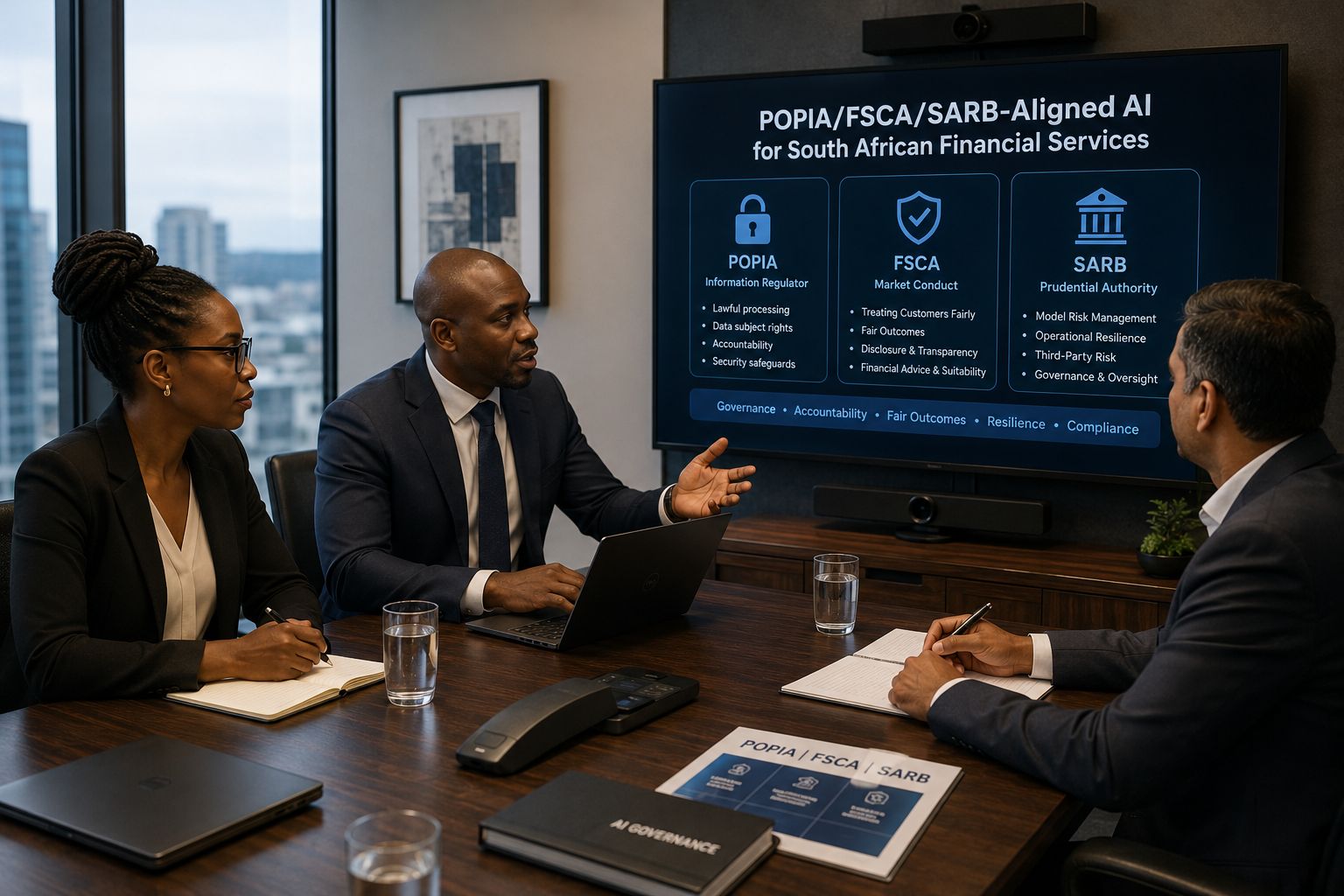
South African financial services operates under three regulators whose expectations now extend explicitly into AI.
The Information Regulator enforces POPIA across all sectors, with specific attention to AI processing of personal information. The FSCA, the Financial Sector Conduct Authority, applies its market conduct framework to AI-driven customer interactions, financial advice, product design, and treating customers fairly. The Prudential Authority, housed within SARB, applies prudential expectations to AI models, AI infrastructure, and the broader operational risk profile of AI in regulated financial institutions.
For SA-licensed banks, insurers, capital markets intermediaries, microfinance lenders, and the broader regulated financial services sector, operating AI in 2026 means operating across all three regulatory regimes simultaneously, plus the broader Africa context for groups whose footprint extends beyond South Africa.
This pillar is a practical guide to what POPIA/FSCA/SARB-aligned AI actually requires, not a regulatory recital, not a vendor pitch. POPIA operationalised for AI processing. FSCA conduct expectations applied to AI-driven customer interactions. SARB prudential expectations for AI models and infrastructure. Information Regulator engagement patterns. The B-BBEE considerations that increasingly matter for SA enterprise procurement. And the cross-Africa pragmatism that distinguishes SA-headquartered groups operating across the continent from groups operating only within the SA regulatory perimeter.
Why the SA regulatory environment is distinctive
Three structural features distinguish SA financial services AI compliance from comparator regimes.
POPIA as the data protection foundation, with the Information Regulator as the active enforcer
POPIA is mature legislation with mature enforcement. The Information Regulator has been progressively active through 2023-2025, issuing enforcement notices, conducting investigations, and clarifying operational expectations through guidance. POPIA's broad scope, narrow exemptions, and explicit operator-responsible-party framework apply directly to AI processing of personal information.
Twin Peaks regulatory architecture
South Africa's Twin Peaks model separates prudential regulation, Prudential Authority within SARB, from market conduct regulation, FSCA. AI in SA financial services attracts attention from both: prudential considerations on model risk, operational resilience, and broader institutional safety; conduct considerations on customer outcomes, treating customers fairly, product suitability, and disclosures. Operating well under both is a different exercise than operating under a single integrated regulator.
The cross-Africa context
SA-headquartered financial groups operate across multiple African markets. Each market has its own data protection regime, Nigeria's NDPA, Kenya's DPA, Ghana's Data Protection Act, Mauritius DPA, Egypt's PDPL, and others, and its own financial services regulators. SA-based AI workloads serving multiple African markets must satisfy the regulatory expectations of each origin jurisdiction plus the SA home-country expectations. The operational picture is more complex than the SA-only picture suggests.
POPIA operationalised for AI processing
POPIA's eight conditions for lawful processing of personal information apply directly to AI processing. Each condition operationalises specifically for AI.
Accountability (condition 1)
The responsible party is accountable for POPIA compliance across the AI processing lifecycle. Designating an Information Officer is mandatory. For AI specifically, the Information Officer needs sufficient understanding of AI processing to discharge their duties, including engagement with model development, deployment decisions, and ongoing monitoring.
Processing limitation (condition 2)
Personal information processed by AI must be processed lawfully, in a reasonable manner, and only for the purpose for which it was collected. Lawful basis under section 11 of POPIA, consent, contractual necessity, legal obligation, legitimate interests of the responsible party, legitimate interests of the data subject, or compliance with public law duty, must be established and documented per AI processing activity.
Purpose specification (condition 3)
Personal information must be collected for specific, explicit, lawful purposes. Reusing information collected for one purpose to train an AI model for a different purpose typically requires fresh basis. AI training data lawful basis is one of the recurring gaps Foundation audit work and broader compliance review identifies in SA financial services.
Further processing limitation (condition 4)
Further processing must be compatible with the original purpose. AI use for purposes beyond the original collection, particularly profiling, cross-product use, and inference at scale, needs explicit consideration of compatibility, with documentation supporting the conclusion.
Information quality (condition 5)
Personal information must be complete, accurate, not misleading, and updated where necessary. AI-generated content that includes or relates to personal information must satisfy accuracy expectations. Generative AI's tendency toward hallucination is a POPIA accuracy issue when the output concerns identifiable individuals.
Openness (condition 6)
Data subjects must be informed about processing. Privacy notices must specifically address AI processing, not generic notices that fail to disclose AI use. Section 18 notifications apply where information is collected directly from the data subject; section 19 notifications apply where information is collected from another source.
Security safeguards (condition 7)
The responsible party must secure personal information against loss, damage, unauthorised access. AI-specific security considerations include prompt injection defences, model security, training data poisoning defences, and supply chain security for foundation model dependencies.
Data subject participation (condition 8)
Data subjects have rights of access, correction, deletion, and to object to processing. AI processing must operationalise these rights, including the harder cases like deletion when training data has been incorporated into a model, and access requests that touch AI-generated content.
Section 71 specifically addresses automated decision-making. A data subject has the right not to be subject to a decision based solely on automated processing that has legal consequences or affects them substantially. The right is not absolute, exemptions exist for contractual necessity and authorised processing, but operationalising it where it applies is part of POPIA-aligned AI.
Information Regulator engagement
The Information Regulator is the supervisory authority for POPIA and PAIA. Its approach to AI has matured through guidance, enforcement, and progressive engagement with regulated entities.
Operational implications:
● Prior authorisation under section 57 may be required for specific processing, including certain processing of children's information, biometric information, criminal behaviour information, and credit reporting information. AI-driven processing in these categories needs section 57 consideration.
● Breach notification under section 22 covers AI-related incidents that compromise personal information, including model security incidents, prompt injection events resulting in data leakage, and supply chain breaches affecting AI training data.
● Annual Information Regulator reporting where applicable.
● Enforcement notices and fines for non-compliance have been issued in increasing numbers through 2023-2025.
● Constructive engagement with the Information Regulator before novel AI deployment is generally productive, particularly for high-risk AI processing.
FSCA conduct expectations applied to AI
The FSCA enforces market conduct across the financial sector. Its expectations apply directly to AI-driven customer interactions, product design, and the broader conduct framework.
Treating Customers Fairly (TCF)
The TCF framework's six outcomes apply to AI-driven customer interactions just as to human-driven ones.
● Outcome 1: customers can be confident they are dealing with firms where TCF is central to corporate culture. AI deployment decisions that prioritise commercial outcomes over customer fairness affect this outcome at the cultural level.
● Outcome 2: products and services marketed and sold are designed to meet the needs of identified customer groups and are targeted accordingly. AI-driven targeting and product design must align with this outcome.
● Outcome 3: customers are provided with clear information and are kept appropriately informed before, during, and after the point of sale. AI-generated customer communications must support clarity, not just technical compliance.
● Outcome 4: where customers receive advice, the advice is suitable. AI-driven advice or AI-augmented advice must satisfy suitability requirements.
● Outcome 5: products perform as firms have led customers to expect, and the service is of an acceptable standard. AI-driven service delivery, chatbots, AI agents, AI-assisted support, must meet this expectation.
● Outcome 6: customers do not face unreasonable post-sale barriers to change product, switch provider, submit a claim, or make a complaint. AI in claims handling, retention, and complaint management must not create unreasonable barriers.
Conduct Standards and sector-specific rules
FSCA Conduct Standards in specific areas apply to AI use within those areas. Examples include conduct expectations for retail investment products, insurance, retirement funds, and broader sector-specific frameworks. AI used in these contexts must satisfy the underlying conduct expectations, with AI use neither weakening nor undermining the conduct standard.
Specific AI considerations
FSCA engagement on AI has clarified several specific considerations through 2023-2025. AI-driven affordability assessments and credit decisions must comply with NCA requirements where applicable. AI in financial advice must operate consistently with FAIS requirements including suitability and disclosure. AI used in customer onboarding must satisfy FICA requirements including verification and due diligence.
SARB prudential expectations applied to AI
The Prudential Authority, housed within SARB, regulates the prudential safety and soundness of financial institutions. AI raises specific prudential considerations.
Model risk management
PA expectations on model risk apply to AI models used in regulated activities. The expectations cover the full model lifecycle, inventory, documentation, validation, ongoing monitoring, periodic revalidation, change management, and decommissioning. For generative AI and foundation models, the expectations extend with the principle that the institution remains accountable for model risk regardless of where in the AI supply chain the risk originates.
Operational risk and resilience
AI is part of the institution's broader operational risk profile. PA expectations on operational risk extend to AI, including availability, capacity, disaster recovery, business continuity, and supplier dependency for foundation model vendors and AI infrastructure providers.
Cyber resilience
PA cyber resilience expectations cover AI-specific cyber risks, prompt injection, model extraction, training data poisoning, supply chain security for foundation model dependencies. AI workloads are not exempt from cyber resilience expectations because they are AI; they attract additional considerations specific to AI risk.
Outsourcing and third-party arrangements
Material AI dependencies, foundation model vendors, cloud AI services, specialised AI tooling, are typically material outsourcing arrangements under PA expectations. Due diligence, contractual provisions, ongoing oversight, and exit planning apply. Foreign-located AI providers attract specific consideration including cross-border data flow implications, supervisory access, and operational resilience under cross-border dependency.
B-BBEE considerations for AI procurement and partnership
B-BBEE, Broad-Based Black Economic Empowerment, is a substantive consideration in SA enterprise procurement, particularly for public sector AI and for large private sector engagements. Suppliers' B-BBEE level affects procurement preferences, public sector eligibility, and customer commercial decisions.
For AI specifically:
● Foundation model vendor selection and AI tooling procurement increasingly include B-BBEE considerations in addition to capability and price.
● Local content and skills development, including transfer of AI capability to South African talent, figures into B-BBEE scoring across multiple categories.
● Ownership, management control, and enterprise development categories affect SA suppliers' B-BBEE levels with downstream procurement implications.
● Public sector AI procurement weights B-BBEE significantly; private sector engagements vary but typically consider it.
● Foreign AI vendors and SA-based delivery partners need to consider B-BBEE in their commercial structuring.
The cross-Africa context
SA-headquartered financial groups operate across multiple African markets. Each market has its own regulatory regime; AI workloads spanning markets must satisfy each origin jurisdiction.
Nigeria: NDPA and CBN expectations
Nigeria's Data Protection Act 2023 and the NDPC's regulatory practice cover Nigerian residents' data subject to AI processing. The Central Bank of Nigeria has specific expectations for AI in regulated financial services. Cross-border data flows from Nigeria require specific consideration.
Kenya: DPA and CBK
Kenya's Data Protection Act 2019 and the Office of the Data Protection Commissioner regulate Kenyan resident data. The Central Bank of Kenya regulates financial services. AI workloads serving Kenyan customers need to satisfy both regimes.
Ghana: DPA and BoG
Ghana's Data Protection Act 2012 and the Data Protection Commission cover Ghanaian residents. The Bank of Ghana regulates financial services. Specific provisions on cross-border data and AI processing have been progressively clarified.
Mauritius: DPA and BoM
Mauritius's Data Protection Act 2017 and the Data Protection Office, plus the Bank of Mauritius for financial services, govern Mauritian operations. Mauritius is also a common regional hub for SA-headquartered groups' Africa operations, with specific implications.
Other markets and the broader picture
Egypt's PDPL, Morocco's data protection framework, Rwanda's data protection regime, Botswana's DPA, Namibia's DPA, and others each apply. SA-headquartered groups operating across Africa generally adopt a 'satisfy the strictest applicable framework and apply broadly' approach to AI compliance, operationally simpler than country-by-country variants, while respecting jurisdictional specifics where they materially differ.
Mobile money infrastructure, USSD-based service delivery, low-bandwidth design constraints, and language diversity, Swahili, French, Portuguese, Arabic, and local languages alongside English, shape AI delivery across Africa in ways that differ materially from SA-only delivery. Pragmatism about what works in cross-Africa contexts is part of the SA-headquartered group's operating discipline.
What good POPIA/FSCA/SARB-aligned AI looks like
● AI governance framework operationalising POPIA conditions, FSCA conduct expectations, and PA prudential expectations as one integrated programme.
● Information Officer with sufficient AI understanding to discharge POPIA accountability, supported by AI governance committee with named accountability.
● Complete AI inventory across all material AI systems, classified by risk and mapped to applicable regulatory regimes.
● Lawful basis under section 11 documented per AI processing activity, with specific attention to training data and further processing considerations.
● Section 71 automated decision-making provisions operationalised where applicable.
● TCF outcomes applied specifically to AI-driven customer interactions, with documented testing and monitoring.
● Model risk management aligned with PA expectations, extended to generative AI and foundation models.
● Operational resilience covering AI dependencies including foundation model vendors, with credible exit planning.
● B-BBEE strategy integrated with AI vendor selection and partnership structuring.
● Cross-Africa compliance architecture for groups operating beyond SA, with strictest applicable framework as operational baseline.
● Continuous evidence base ready for Information Regulator, FSCA, and PA engagement.
What bad POPIA/FSCA/SARB-aligned AI looks like
● POPIA treated as a privacy notice exercise, accountability nominal, Information Officer disconnected from AI decision-making.
● FSCA TCF applied to non-AI activities but not extended to AI-driven customer interactions.
● PA prudential expectations addressed reactively, preparing for examination when the PA asks, rather than continuously.
● Model risk management treated as a Basel-driven exercise without extension to generative AI workloads.
● Section 71 automated decision-making provisions ignored on the basis that 'we have human review' when human review is rubber-stamping.
● Training data lawful basis assumed rather than documented.
● Foundation model vendor contracts signed without consideration of cross-border data flow implications.
● Cross-Africa operations handled country-by-country with no coordinating architecture.
● B-BBEE considered only at tender response stage, not as operational discipline.
● Information Regulator engagement treated as confrontational rather than constructive, reactive to enforcement rather than proactive on novel deployment.
The 12-month implementation roadmap
Standing up POPIA/FSCA/SARB-aligned AI is not a one-quarter project. A credible 12-month roadmap for an SA-licensed financial institution runs in four phases.
Phase 1 (Months 1-3): Baseline, inventory, regulatory mapping
Build complete AI inventory. Map each system to POPIA conditions, FSCA conduct expectations, PA prudential expectations, and where applicable cross-Africa regulatory regimes. Engage the Board on AI risk appetite. Output: a board-ready baseline assessment and a remediation roadmap with effort and dependency estimates.
Phase 2 (Months 4-6): Framework operationalisation
Adopt or refine the AI governance framework. Stand up the AI governance committee with charter and decision rights. Operationalise POPIA conditions per AI processing activity. Implement TCF testing for AI-driven customer interactions. Establish model risk management for AI. Engage Information Regulator on novel high-risk processing where applicable. Output: published framework, operating governance committee, regulatory engagement initiated.
Phase 3 (Months 7-9): Integration and cross-Africa alignment
Integrate AI governance with existing risk and compliance functions. Conduct internal assurance against the three regulatory regimes. Address cross-Africa compliance for relevant operations. Integrate B-BBEE strategy with AI procurement and partnership decisions. Output: integrated governance, cross-Africa architecture, B-BBEE integrated.
Phase 4 (Months 10-12): Supervisory and examination readiness
Build the evidence base for Information Regulator, FSCA, and PA engagement. Conduct internal mock supervisory dialogues. Address gaps. Establish ongoing operating rhythm, quarterly POPIA reviews, periodic FSCA TCF assessments, annual PA prudential review, continuous cross-Africa monitoring. Output: a steady-state AI governance function ready for SA regulatory engagement and continuous operation.
The shift to make
Stop treating SA financial services AI compliance as three parallel projects, one for POPIA, one for FSCA, one for SARB.
Start treating it as one integrated AI governance posture operationalising all three regimes as one programme, with the cross-Africa context built in for groups operating beyond SA, with B-BBEE strategy integrated rather than bolted on, and with the operational pragmatism that SA financial services delivery requires.
SA financial institutions operating well under this approach earn three durable advantages. Defensible regulatory positioning across all three SA regulators plus cross-Africa supervisory relationships. Customer trust built through demonstrable governance rather than asserted compliance. And operating capability that scales naturally across the continent, the discipline required for SA's three-regulator environment translates well to other major African markets as their regulatory frameworks mature.
SA financial institutions that don't operate this way face the opposite, siloed compliance with predictable gaps, customer trust that erodes when AI issues surface, and operational capability that doesn't scale beyond SA because the underlying discipline was never built. The cost difference between the two postures becomes visible in every AI deployment, every supervisory engagement, and every cross-Africa expansion the firm pursues from here on.
Frequently asked questions
Does POPIA section 71 effectively prohibit AI decision-making?
No. Section 71 establishes a data subject right not to be subject to a decision based solely on automated processing that has legal consequences or substantial effects. Exemptions apply where the decision is necessary for the conclusion or performance of a contract, where authorised by law with appropriate safeguards, or where based on the data subject's express consent. Most consequential AI decisions in financial services fall within the contractual necessity exemption, with the responsible party still obliged to provide appropriate safeguards, typically meaningful human review for adverse outcomes, transparency about the automated processing, and the ability for the data subject to contest.
How does the FSCA approach AI specifically, through TCF or through specific AI guidance?
Both. TCF is the framing through which the FSCA approaches conduct broadly, with AI implications addressed by extension. Sector-specific Conduct Standards apply where AI is used in their domain. Specific FSCA guidance on AI has been progressively published and continues to develop. The practical answer: AI in regulated financial services activities is examined against the underlying conduct framework that applies to those activities, with AI use neither weakening nor undermining the conduct standard. Specific FSCA AI guidance complements this rather than replacing it.
What's the PA's stance on foundation model vendors?
Foundation model vendors are typically material third parties under PA outsourcing expectations. The institution remains accountable for model risk arising from the use, regardless of where in the supply chain the model originates. PA expectations include due diligence on the vendor, contractual provisions addressing supervisory access and operational requirements, ongoing oversight, and credible exit planning. Foreign-located foundation model vendors attract additional considerations including cross-border data flow implications and operational resilience under cross-border dependency. The PA's approach has been evolving; current engagement on novel AI vendor relationships is generally productive.
How does B-BBEE actually affect AI procurement?
B-BBEE scoring affects supplier eligibility for public sector procurement and influences private sector procurement preferences. Suppliers' B-BBEE levels are determined by audited assessment across multiple categories, ownership, management control, skills development, enterprise and supplier development, socio-economic development. For AI specifically, B-BBEE considerations include local content in AI delivery, transfer of AI skills to South African talent, ownership and management of SA-based AI delivery partners, and broader contribution to SA economic transformation. AI vendors selling into SA enterprise, particularly into public sector, generally find B-BBEE considerations material to their commercial prospects.
How do we handle AI workloads serving multiple African markets from SA infrastructure?
Three architectural patterns work. Pattern 1: data classification driving processing locations, with sensitive personal information processed in country of origin and only appropriately handled data flowing to SA-based regional processing. Pattern 2: SA-centred processing with cross-border data flow mechanisms, adequacy, contractual safeguards, binding corporate rules, supporting each origin jurisdiction's transfer requirements. Pattern 3: hybrid with country-specific processing for highest-sensitivity workloads and SA-centred processing for lower-sensitivity workloads. The right pattern depends on the workload profile, the regulatory expectations of relevant origin jurisdictions, and the operational economics. Patterns can coexist within a single group across different workloads.
How long does it take to build POPIA/FSCA/SARB-aligned AI from a starting point of basic compliance?
For a mid-sized SA-licensed financial institution with AI use across multiple regulated activities, 9 to 12 months to stand up the foundational programme. Larger institutions with cross-Africa operations and complex AI portfolios may take 12 to 18 months. The build-out time matters most for institutions that have not integrated AI governance with their broader risk and compliance functions; institutions with mature risk management can typically extend existing capabilities to cover AI in less time. Ongoing operating cost is significantly lower than build-out once the foundation is in place.
What's the right reporting structure for AI governance in an SA financial institution?
Three patterns work. Pattern 1: Chief Risk Officer with AI risk as a defined component, supported by Chief Data Officer and Information Officer with cross-functional coordination. Suitable for institutions where AI is significant but not core. Pattern 2: Chief AI Officer or Head of AI reporting to the CEO, with cross-functional dotted lines into CRO, CCO, CIO, Information Officer. Suitable for institutions where AI is core to the business model. Pattern 3: AI governance distributed across CRO, Information Officer, Chief Compliance Officer, with cross-functional committee coordinating. Suitable for institutions with strong existing risk and compliance functions. The Information Officer designation under POPIA is a structural constant across all patterns. POPIA accountability cannot be diffused regardless of broader governance structure.